New Historicist Architecture, New Traditional Architecture and Montacute Pavilion, Daylesford, Victoria, Australia
This essay provides a succinct introduction to the principles of New Historicist architecture as it applies to the example of Montacute Pavilion, Daylesford, Victoria, Australia.
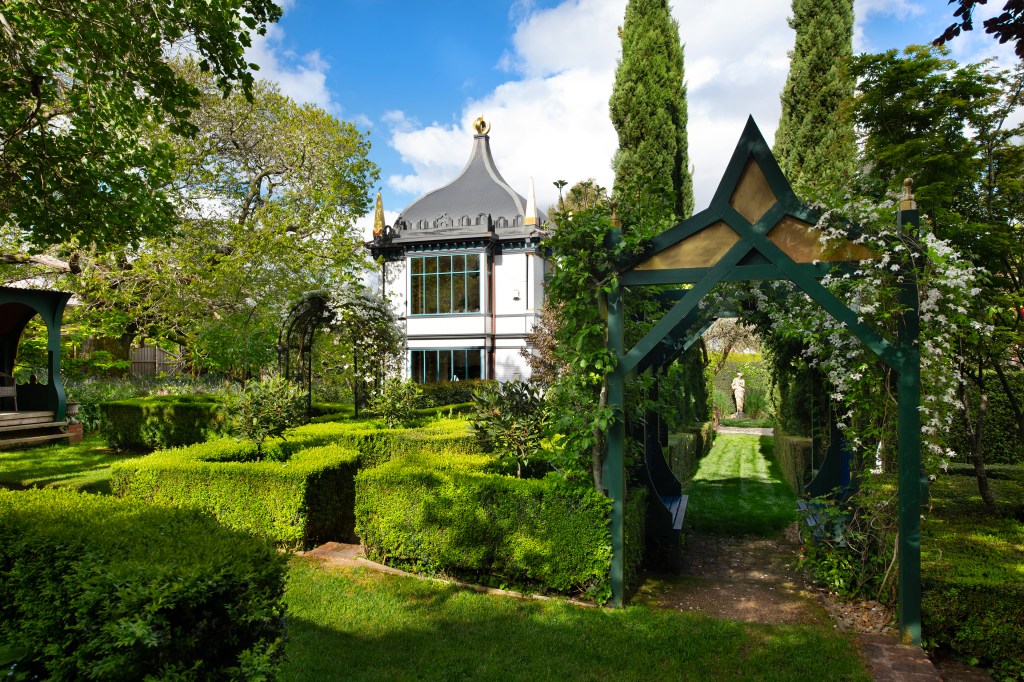
Montacute Pavilion is a small house in Daylesford that was created in 2016 as holiday accommodation and forestiera, although its primary purpose was to explore the concept of New Historicist Architecture. If my primary purpose I had been to get into the short-term accommodation business I would have built something simpler, but it seemed at the time to be an appropriate use for the kind of structure I wanted to build. The idea was that it formed a garden fabrique ornamenting the garden and subordinate to the main house, and he first idea was to make it half-size.
The town of Daylesford was laid out in 1854, at the end of the Victorian gold rush. A double allotment on the south side of Wombat Hill bordering three streets was bought by a miner, evidently in order to sink a shaft to the main gold seam, but he was in the wrong place. A house was built in the middle of this double allotment in the 1890s. In the 1890s a Victorian bay-windowed weatherboard house was set down in the middle of two of the original allotments, facing south. Variouis treeswere planted atthis time, including a row of three sweet chestnut trees. Montacute Pavilion was built in 2016 at the east edge of this property, nestled into the chestnut trees.
The model: the pavilions of Montacute House, Somerset, England
The point about Montacute Pavilion is that it is based on an historic European model.
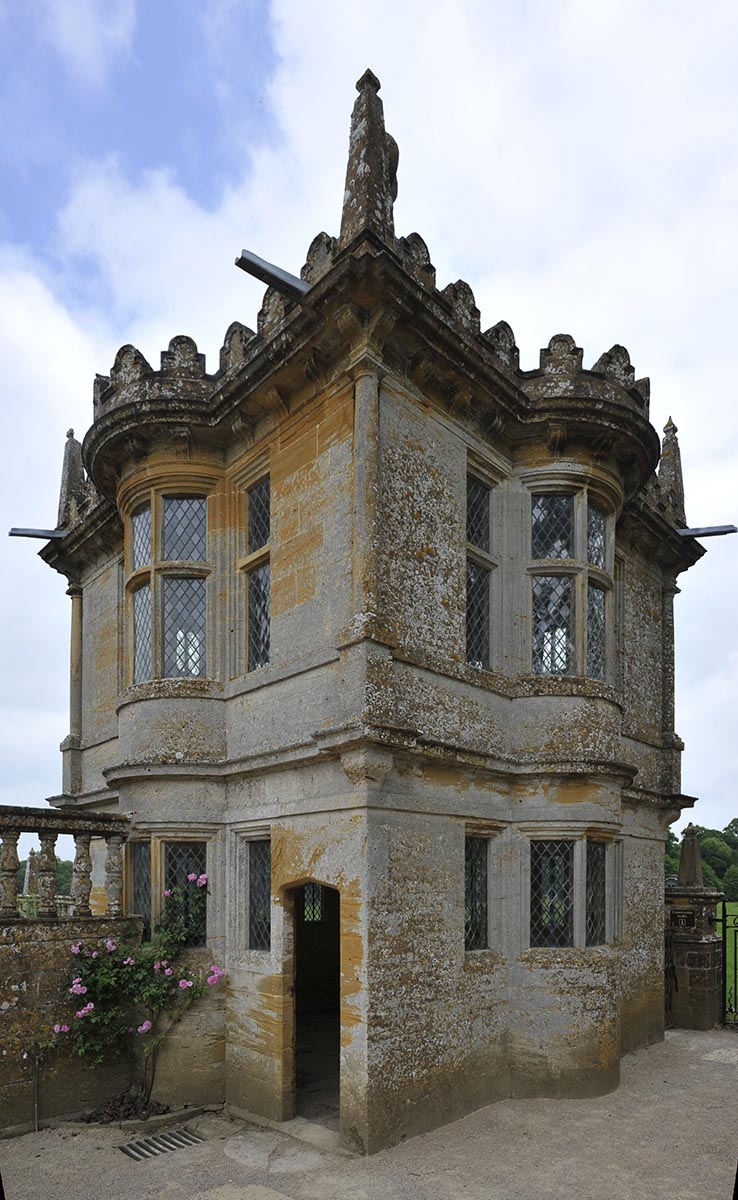
This model is two small pavilions at Montacute House, Somerset.
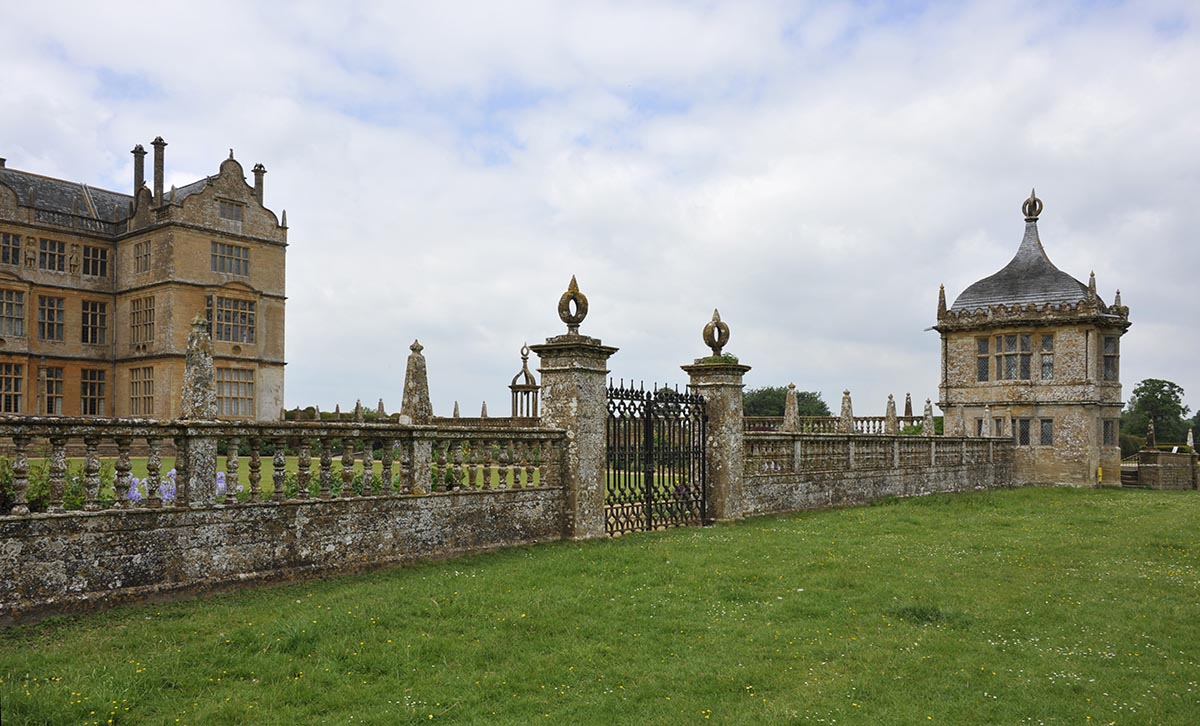
They were built c.1600 and are placed at the corners of what was originally the forecourt of Montacute House. Between them there was once an entrance gateway, but this is long gone.
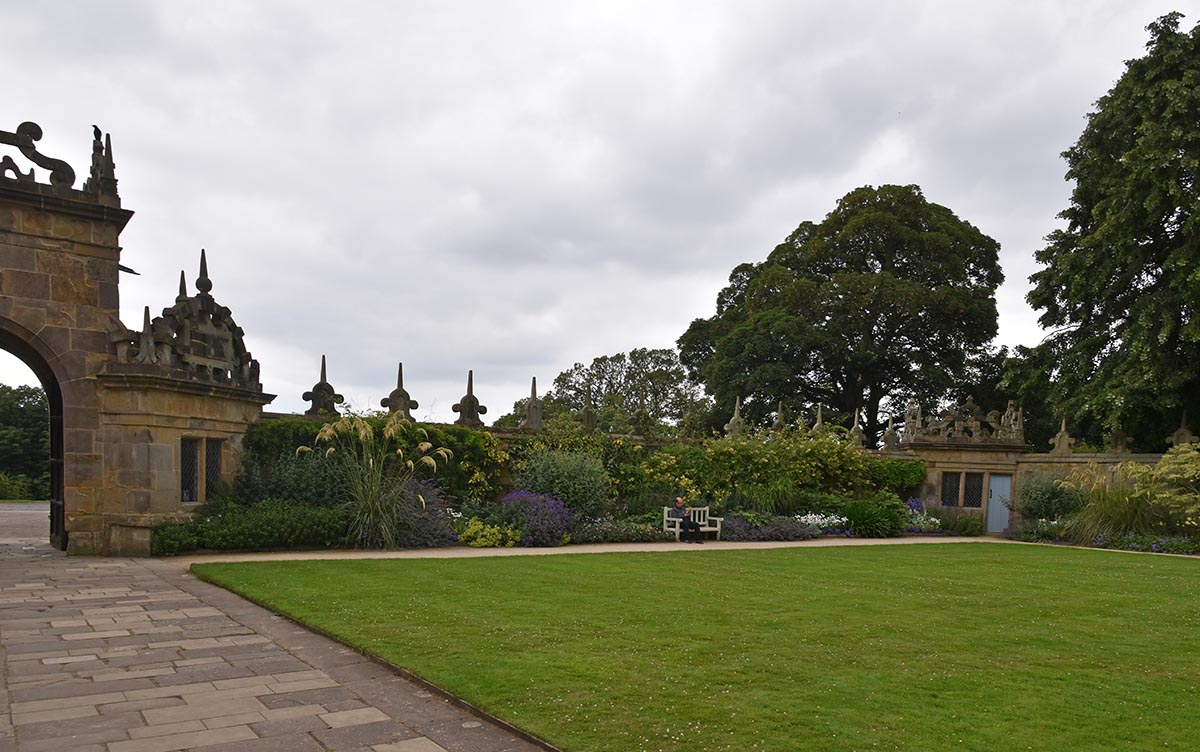
This arrangement survives in the greatest of Elizabethan Houses, Hardwick Hall, but there the pavilions are more basic.
As an art, architecture and garden historian working on Early Modern European art, I have always admired the Montacute pavilions.
The model for the Daylesford building might have been something different, but I liked this model aesthetically and thought I could make it work in the context of the garden.
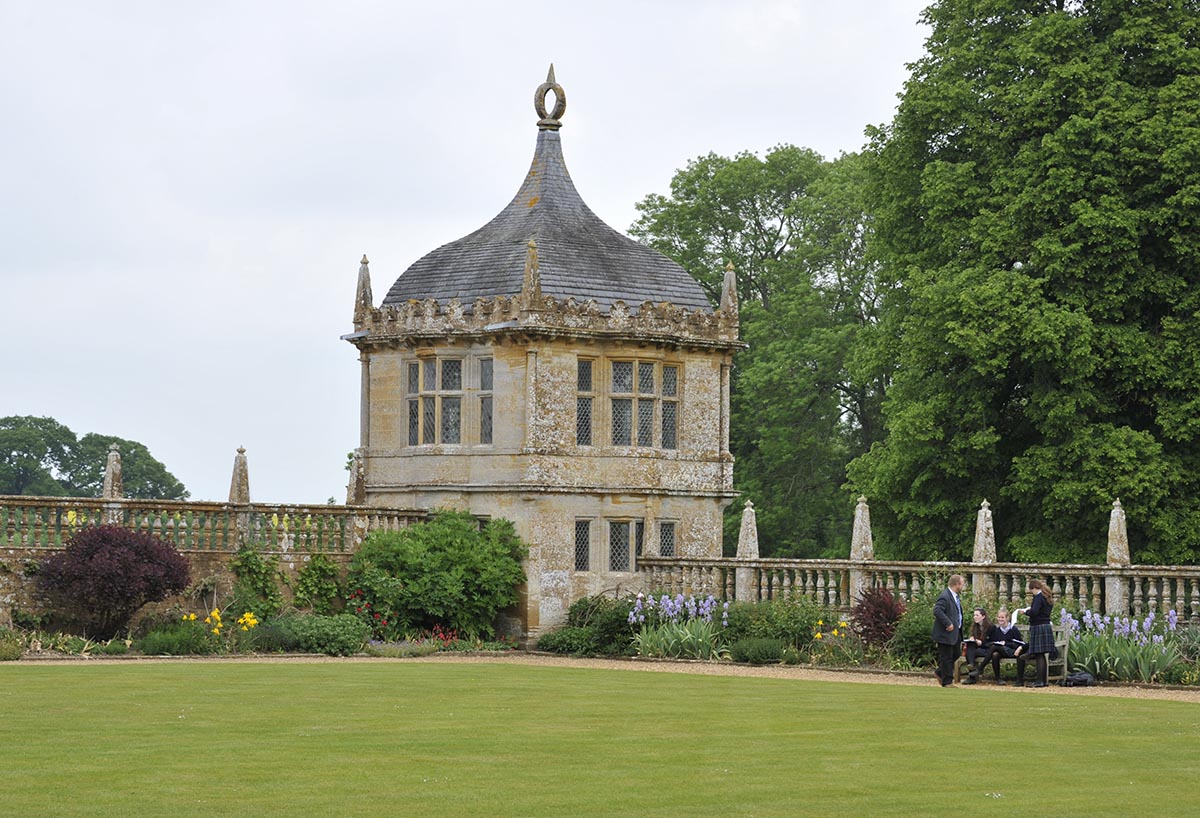
- (left) One of the banqueting houses, Montacute House, Somerset, c. 1600
- (above right) The forecourt of Hardwick Hall, with the entrance gateway at left and one of the banqueting houses at right
- The forecourt of Montacute House, showing the house at left, gateposts where the entrance gateway used to be, and the right-hand banqueting house.
The Evils of Historicism
Most people in Australia today find it hard to accept that one could build a house following a model. For architects, it is an impossibility.
Architectural theory in the twentieth century has one inviolable premise: historicism is bad.
Architects repeat to this day polemics formulated a century and a half ago against the historicism of late nineteenth century architecture. For example, the 2024 prospectus for the property development Middleton Fields, on the other side of Wombat Hill from Montacute Pavilion, requires that the buyer must agree to certain rules.
The appearance of all homes must be of a high-quality contemporary design which complements the Daylesford character and the natural landscape. All historical styles or replica heritage design are prohibited including Colonial, Georgian, Victorian, Federation, Art Deco, 1950s-1980s brick veneer, and French Provincial.[1]
Setting aside such dubious constructions as ‘the Daylesford character’ (an echo, perhaps, of the planning concept of ‘neighbourhood character’), this is a very old-fashioned prescription predicated on a now-outdated belief in period styles. In 1870 or thereabouts it was asked, if Classicism was the style of the Greco-Roman Period, and Gothic the style of the Medieval Period, what is the style of the Nineteenth Century? The answer came in the early twentieth century: Modernism. This dogma is still repeated by Kevin McCloud in Grand Designs, who in every episode refers to a building being ‘of the twenty-first century’.
The belief in periods was based on German Romantic metaphysical theories that no-one believes in anymore. There is no such thing as a period; it is merely a convenient construction built imaginatively from memories of matters existing in an arbitrary stretch of time, as when one sets out to define ‘the style of the 1980s’. This seems real until you realise you could just as well have asked ‘what is the style of 1977 to 1986?’ The Middleton Fields statement reflects the continuing belief in period-style compartments that was central to twentieth century architectural teaching, which has never really abandoned the ‘epitomisation’ of architectural history as presented by a long-popular textbook, Banister Fletcher’s A History of Architecture on the Comparative Method, especially the 1921 and later editions.[2]
New Historicist Architecture clears away these metaphysical cobwebs by working from models, not periods.
New Traditional Architecture
There is today in various parts of the world a movement sometimes called New Traditional Architecture.
This is particularly strong in Central Europe, where a younger generation asks why post-WW2 reconstruction failed to restore what was destroyed, building instead bland Modernist works. Theoretically speaking, this grass-roots movement tends to get bogged down in an opposition between bad Modernism and good traditional architecture.
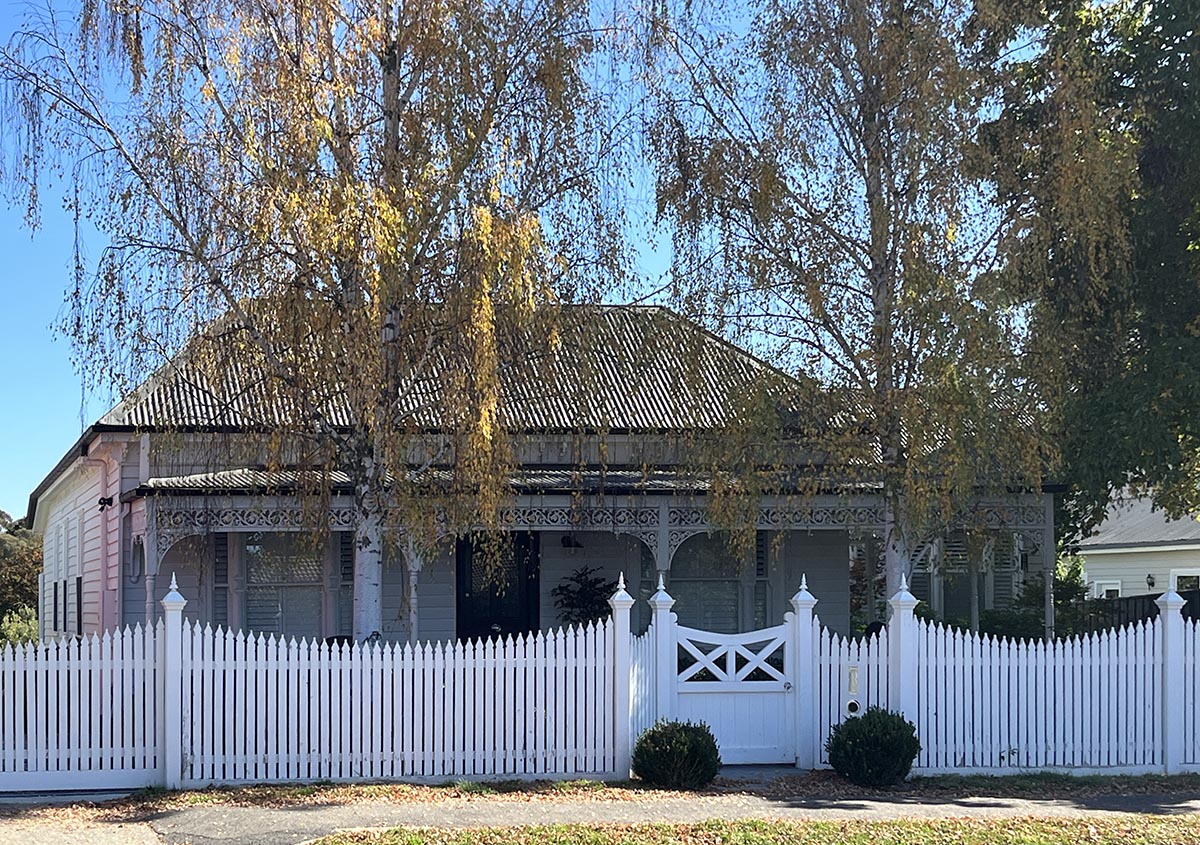
The Australian version of this, which seems to have no theoretical basis and to be driven wholly by demand at a popular level, is new houses modelled on Victorian. These are being built a moderate rate in regional Victoria.
Such houses are new-builds that imitate the style and external materials of standard Victorian spec-built houses of the 1880s and 1890s. They invariably have front verandas, and are (mostly) clad in weatherboards. The interior organisation, however, usually avoids the standard plan of these houses, four squarish rooms on either side of a passageway leading to the front door, with various skillion-roof additions at the back, and is driven by contemporary practice, privileging an open plan living and kitchen space. The shells of original Victorian buildings are similarly being transformed on the inside, so it can be hard to tell ‘new traditional’ Victorian from the real thing.
The point of the new-builds is that the exterior looks like a Victorian house, and is built this way because the buyer or builder admires such houses aesthetically and culturally.
The point of such new buildings is that they are traditional, at least on the outside. They present an image of an idealised past.
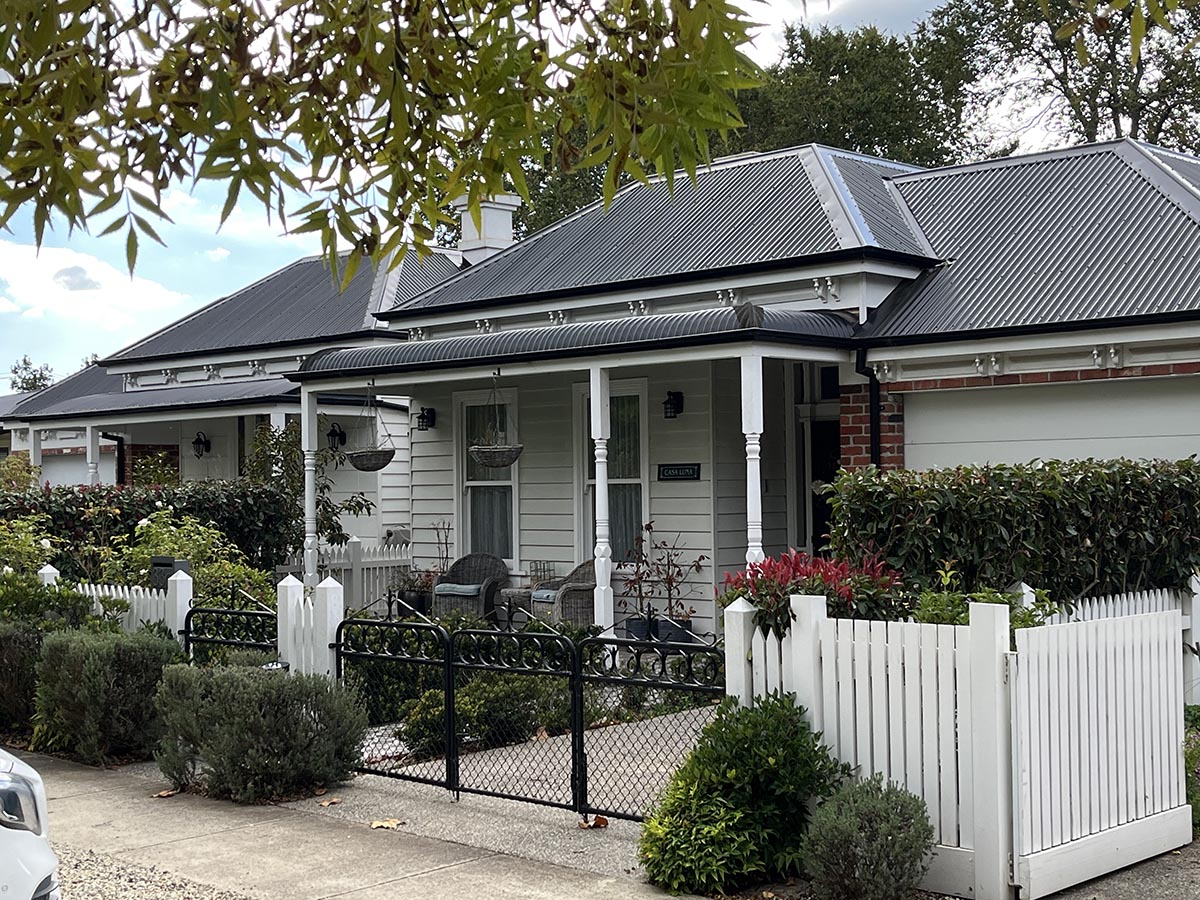
- (left) New houses in Victorian style, Woodend, Vic., c. 2023
- (right) Renovated Victorian House, Hepburn Springs, Vic, c. 1890s, renovated 2020s, with new picket fence
Not an Idealised Past
Montacute pavilion is not like that. It is not traditional. It does not look back to the past.
But it is historicist. That is, it is a building based on an admired model from the past. A model that is beautiful. At least to me. Since no-one really works this way, I call Montacute Pavilion an instance of New Historicist Architecture.
The task with a new-traditional Victorian house is to replicate the external appearance of Victorian houses.
The task with Montacute is to build a house based on an admired model, without losing the qualities that made the model attractive to the creator.
The primary quality is shape.
Materials are secondary.
Materials
The Somerset pavilions are made of stone, with a slate roof.
To copy that would be to create a replica of the building, as can be found in the public gardens at Hamilton, New Zealand.
This appears in a series of set-piece historical garden replicas, and the builders have tried to replicate the materials of the Somerset pavilions as best they could.
They used asphalt tiles instead of slate (actual slate is difficult to use at this scale) and imitation stone blocks for the walls.
This is appropriate to what they are trying to achieve there, which is a microcosm of architectural and garden history.
Montacute pavilion, however, is made on a normal timber frame clad with hardwood shiplap boards, on a concrete slab. The roof is made from pre-formed corrugated steel over a timber truss. All standard building materials.
In materials, the model is neither followed nor imitated.
This is because materials are subordinate to appearance.
Or to put it succinctly: new historicist architecture uses contemporary, practical building materials and processes to recreate the form of the original, not to replicate the building.
This is a rather Platonic theory of architectural design.
A single question controls the design process is: have the essential qualities that made the original beautiful survived, or has the realisation of the design caused them to be lost?
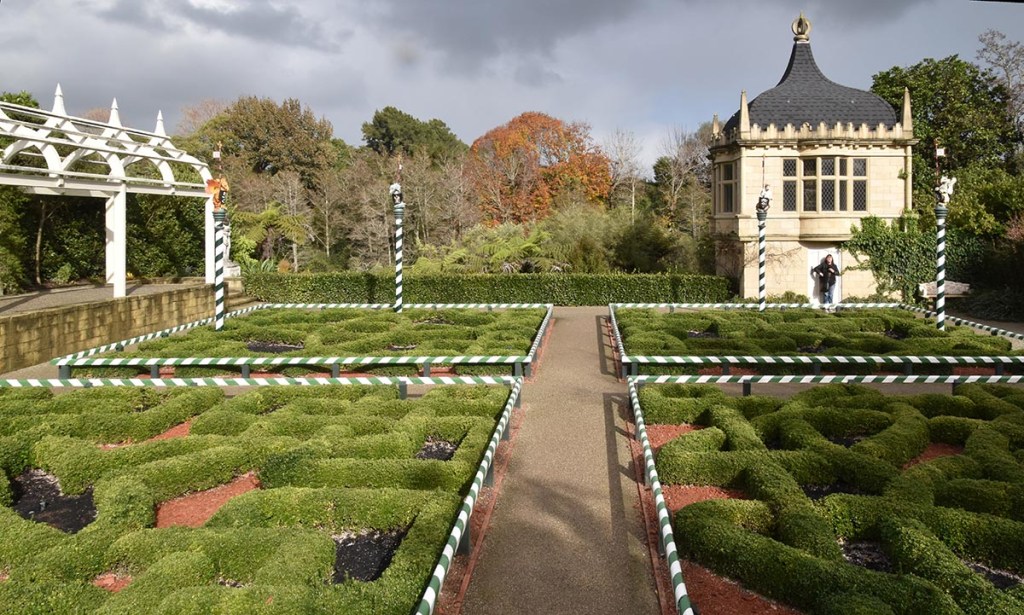
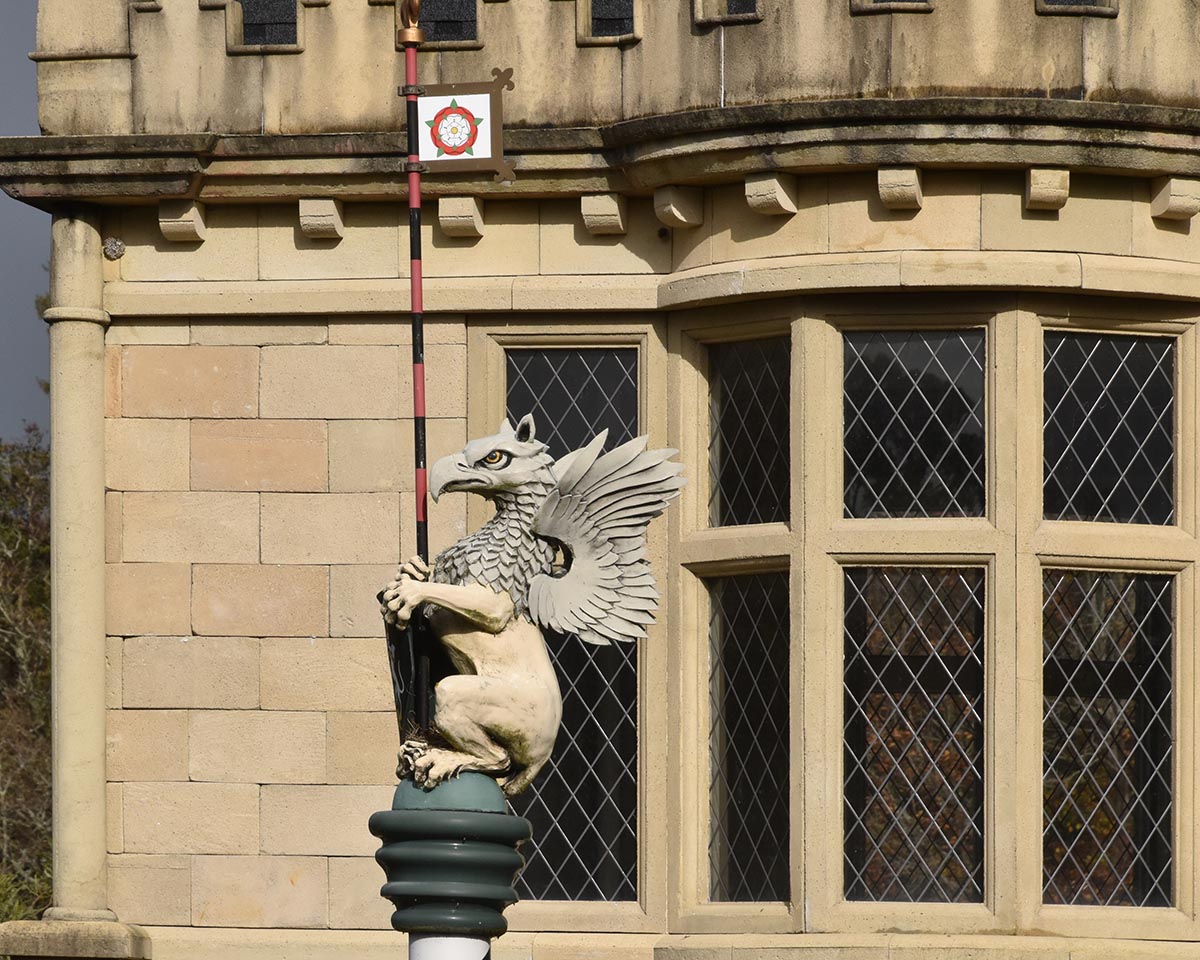
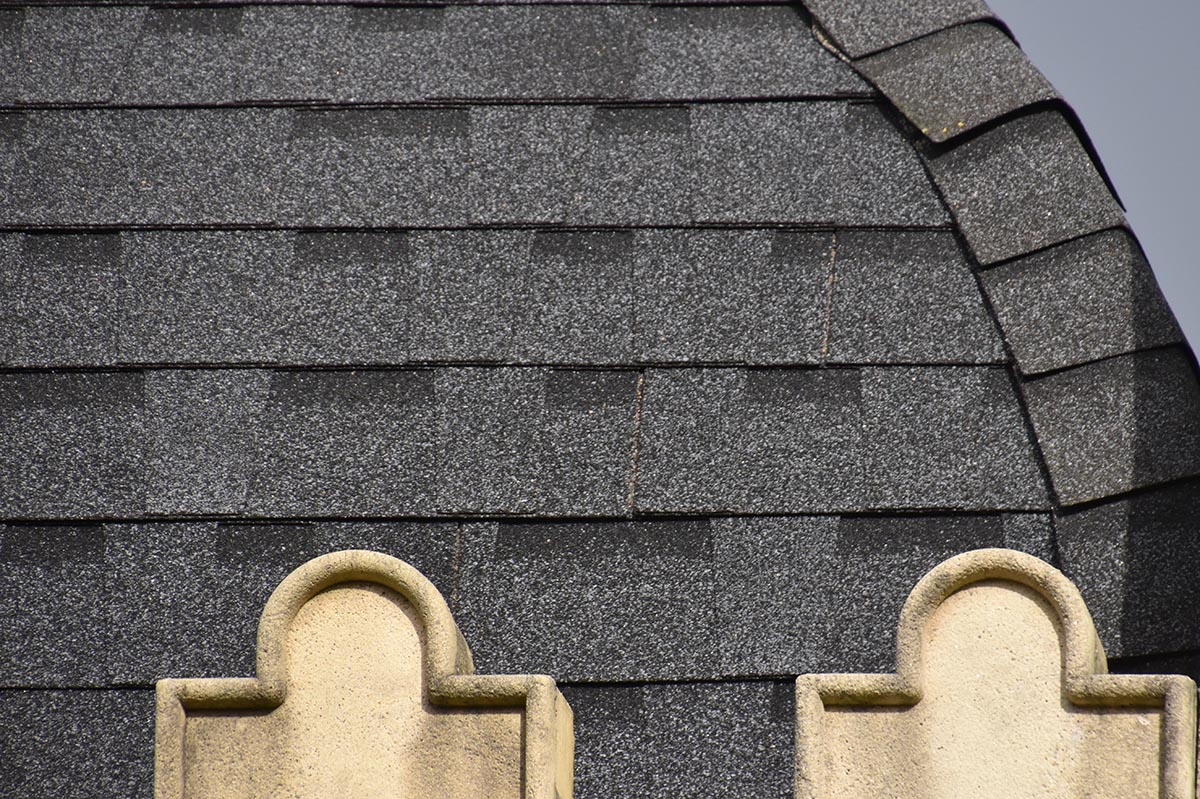
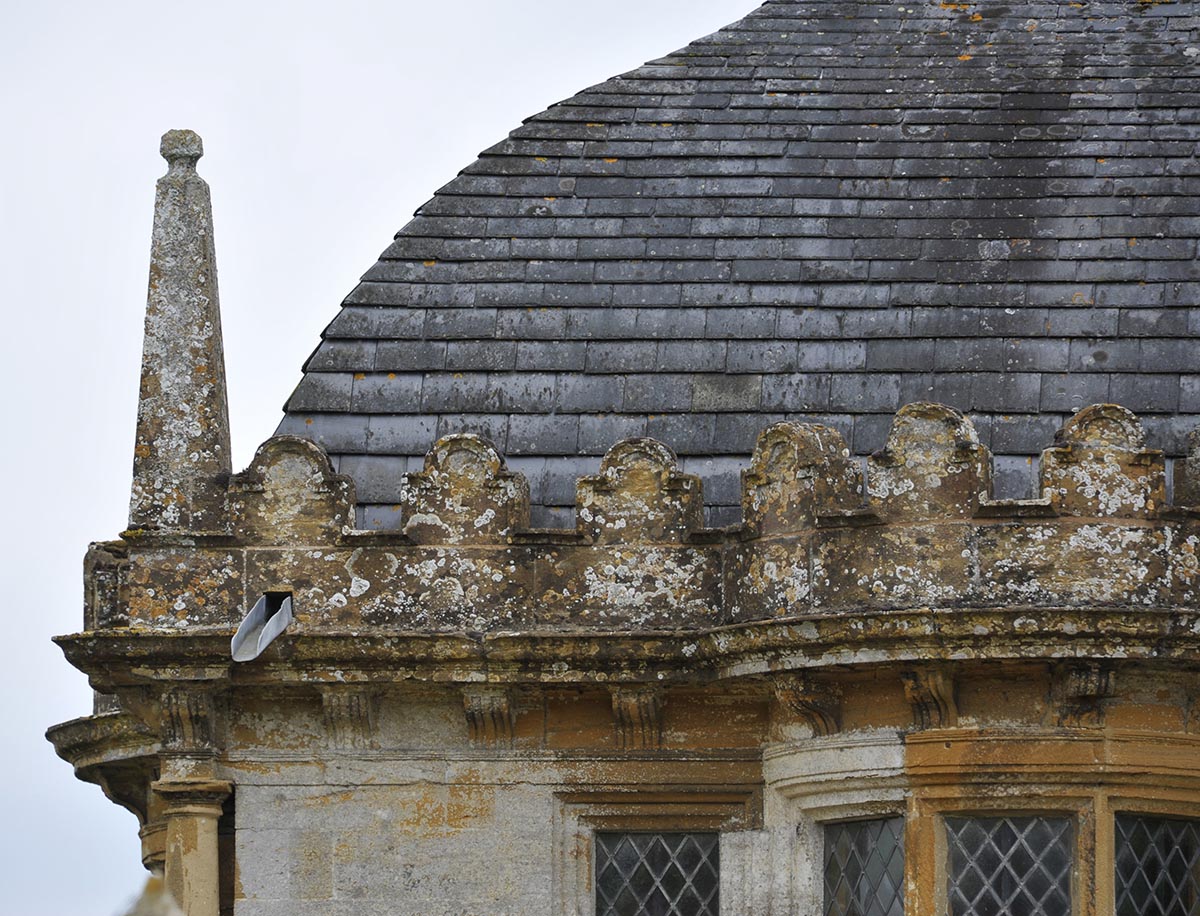
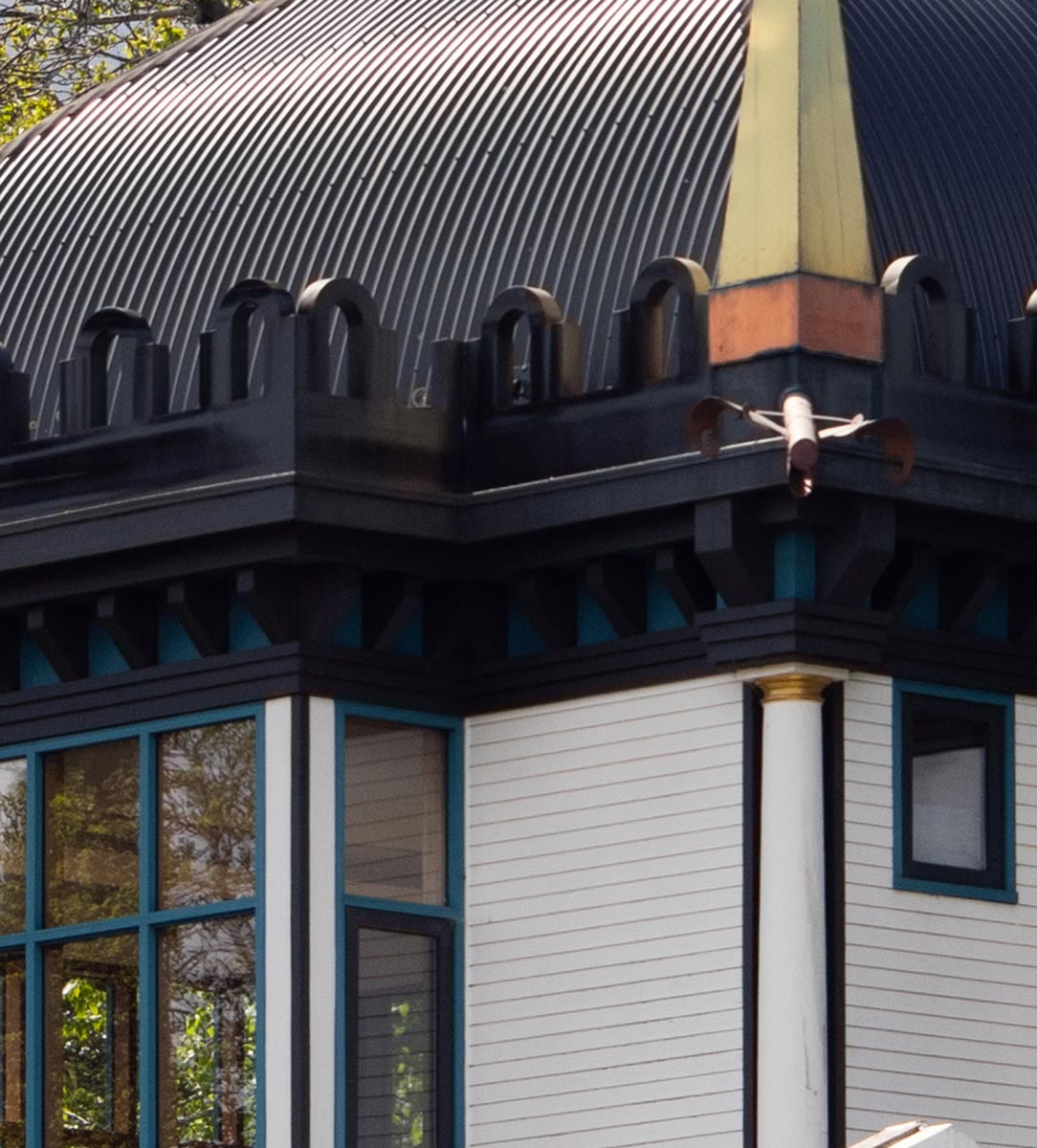
Departures from the model are therefore permitted, in any direction, provided that the vision survives.
- (top and lower left) Tudor Garden, Hamilton Gardens, Hamilton, New Zealand, showing a copy of the Somerset pavilions made from imitation stone blocks and ashphalt roof ‘slates’
- (bottom centre) Roof, battlements, entablature and wall of one of the Somerset pavilions
- (bottom right) Montacute Pavilion: roof of corrugated Colorbond steel, battlements of Accoya, and Australian hardwood shiplap cladding
Departures from the Model
The building is scaled up 20% to provide useful interior spaces. But scaling does not threaten the beauty of the form.
But the windows on the model were of a characteristic Elizabethan type, which were both difficult to realise in wood and provided insufficient space.
And besides, I did not like them much.
Improvement
The point about Platonic theory, which underpinned most architecture, painting and sculpture from the sixteenth to the eighteenth century, is that it aspires to perfection.
This means that you pick the best model and try to improve upon it.
I felt that I could improve on the windows of the Somerset model, not merely change them to a more practical form.
I turned to the bay windows of the main Montacute House, and numerous other Elizabethan and Jacobean Houses, and adapted them to the situation.
Arguably, they look better when seen obliquely.
Practicality and idealist aesthetics, then, can go hand in hand.
Another improvement hat I felt was needed was the battlements and associated ornaments.
Elizabethan architecture demonstrates an interesting interaction between traditional Gothic forms and a new Renaissance interest in Classical forms. The ogee curve (reverse curve) of the roof is a traditional Gothic form that was a favourite roof form in Elizabethan buildings.
The Somerset pavilions were dressed with Classical elements: columns at the corners and a classical entablature with modillions, topped by battlements. By Renaissance standards the battlements are a little rudimentary and so I developed somewhat different ones based on those at another Elizabethan building, Stanway House in the Cotswolds. These are not traditional battlements, but rather an ornamental cresting of a simple but inventive shape without any mouldings without any mouldings. This was both aesthetically satisfying and relatively straightforward to make. They are cut on a bandsaw from solid Accoya, pine treated with vinegar. The columns were cast in concrete from moulds owned by a business in Melbourne that followed ‘correct’ Renaissance models.
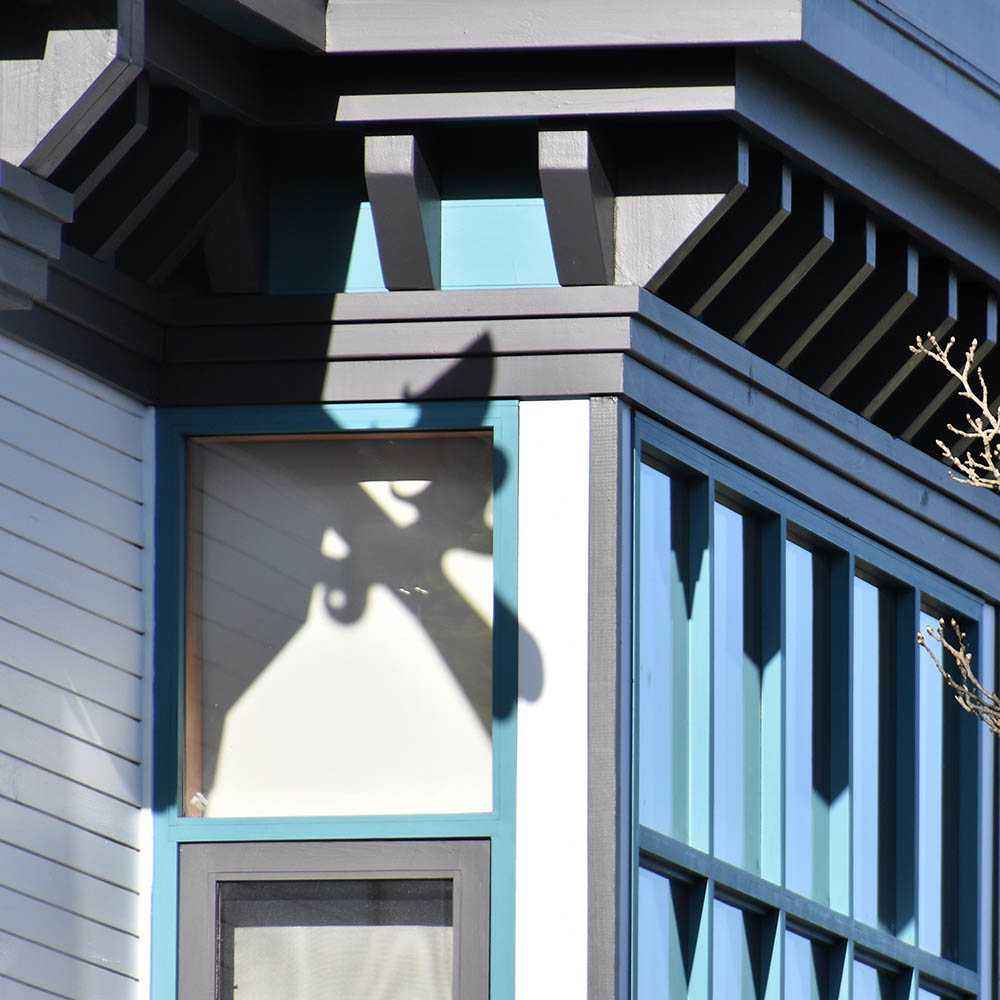
- (left) Somerset pavilion, showing round windows with side lights
- (right) Montacute Pavilion, oblique view of upper bay window
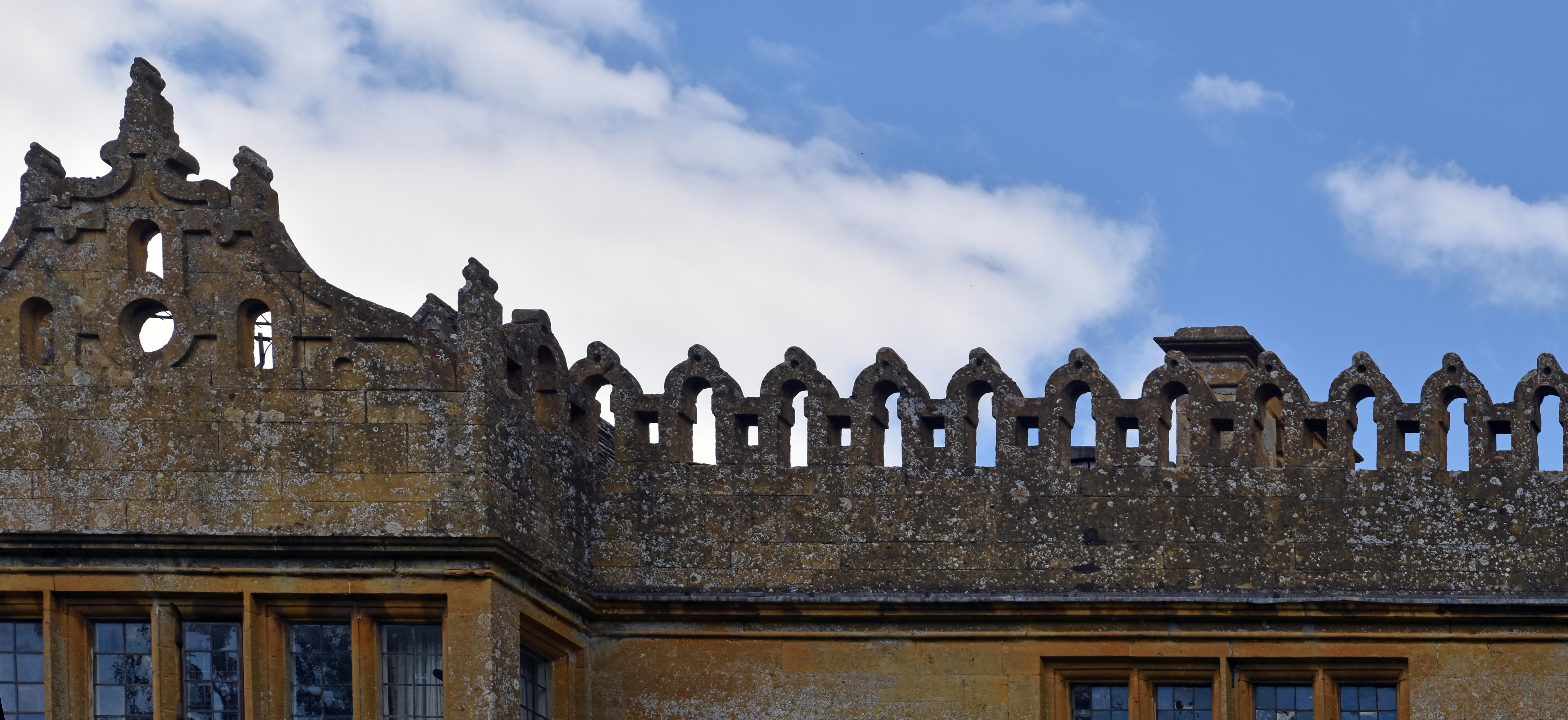
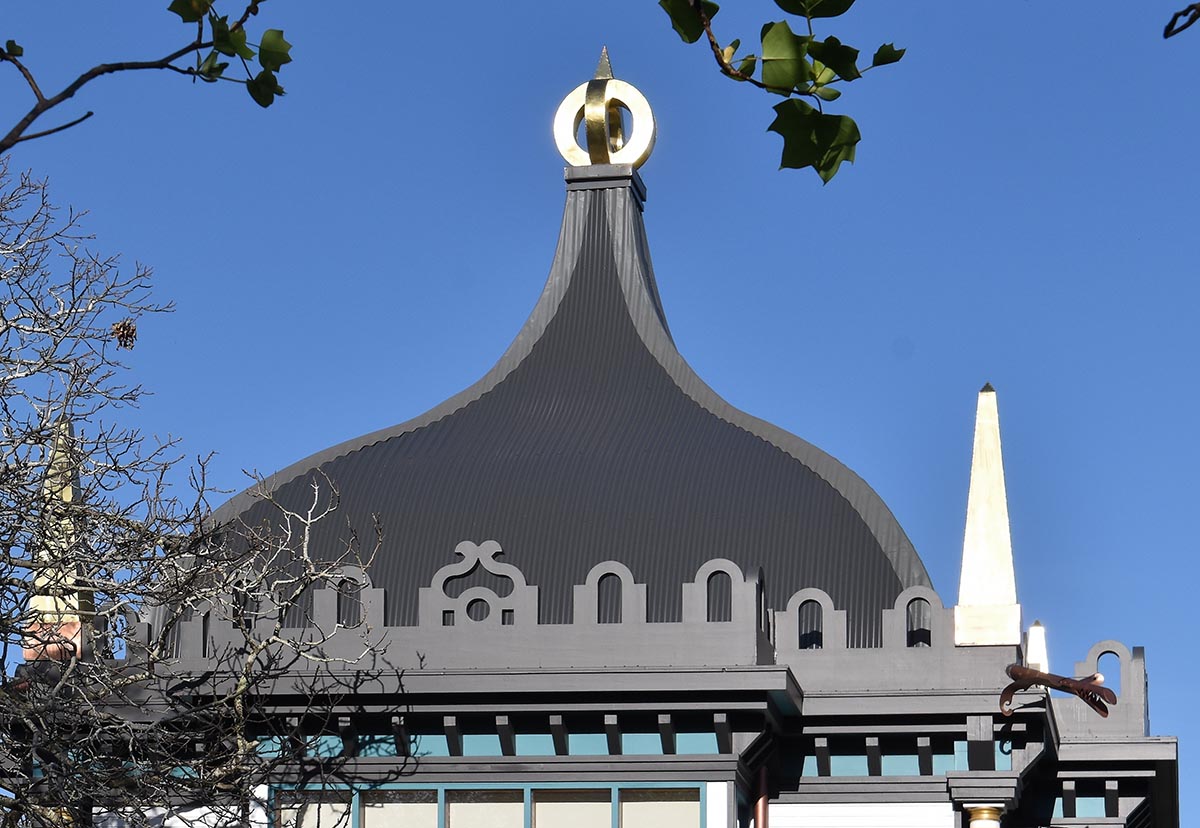
- (top) Battlements of Stanway House
- (bottom) Battlements of Montacute Pavilion
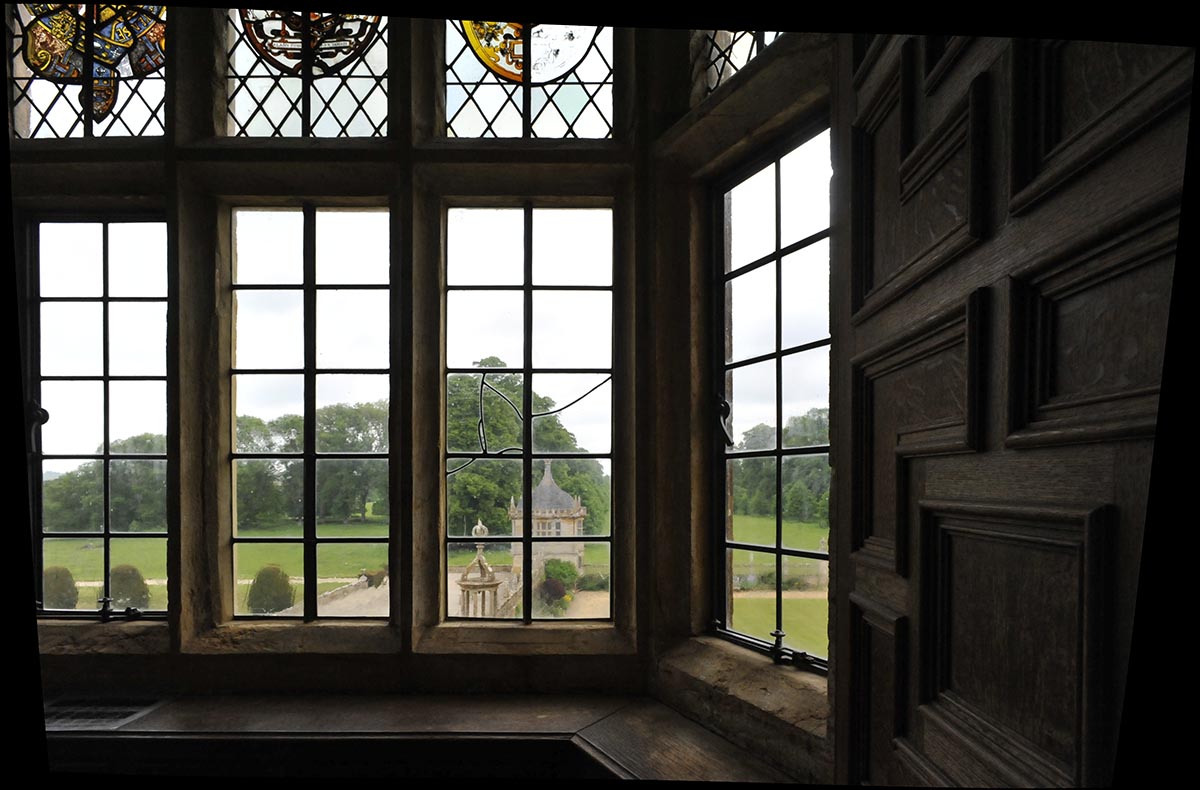
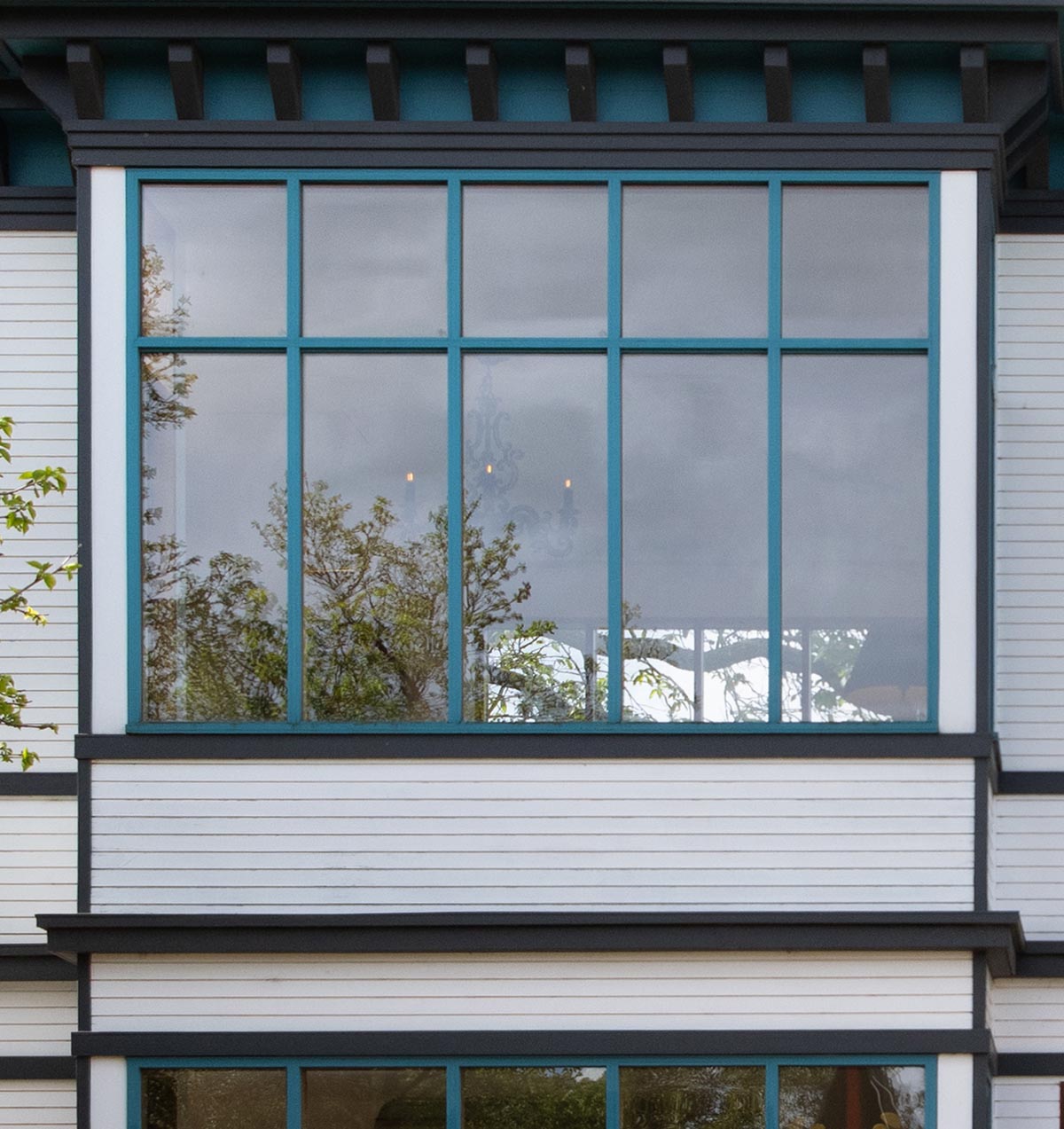
- (left) Interior of bay window upstairs, Montacute House, with one of the pavilions in the distance
- (right) Upstairs south bay window, Montacute Pavilion
Mixing Models
In the case of the battlements based on Stanway house, improvement leads to drawing on other models. Because New Historicist Architecture is based on models, there need not be a single model. There is no requirement to be faithful to the initial model. It is not a matter of ideology, but aesthetics. What matters is that the qualities that made the model attractive in the first place are no lost.
The New Historicist loves discovering interesting forms in old buildings, so it is hard to stop at the choice of the primary model.
Another instance is the staircase. Function demanded this, and it seemed an opportunity to turn to another model, the staircase at Castle Drogo by Lutyens. This staircase has full height windows with Elizabethan-type vertical divisions, and the effect, externally and especially internally, is dramatic. By drawing on his model I hoped to claim some of his drama, even the derivation may not be immediately obvious and the whole is obviously rather more modest.
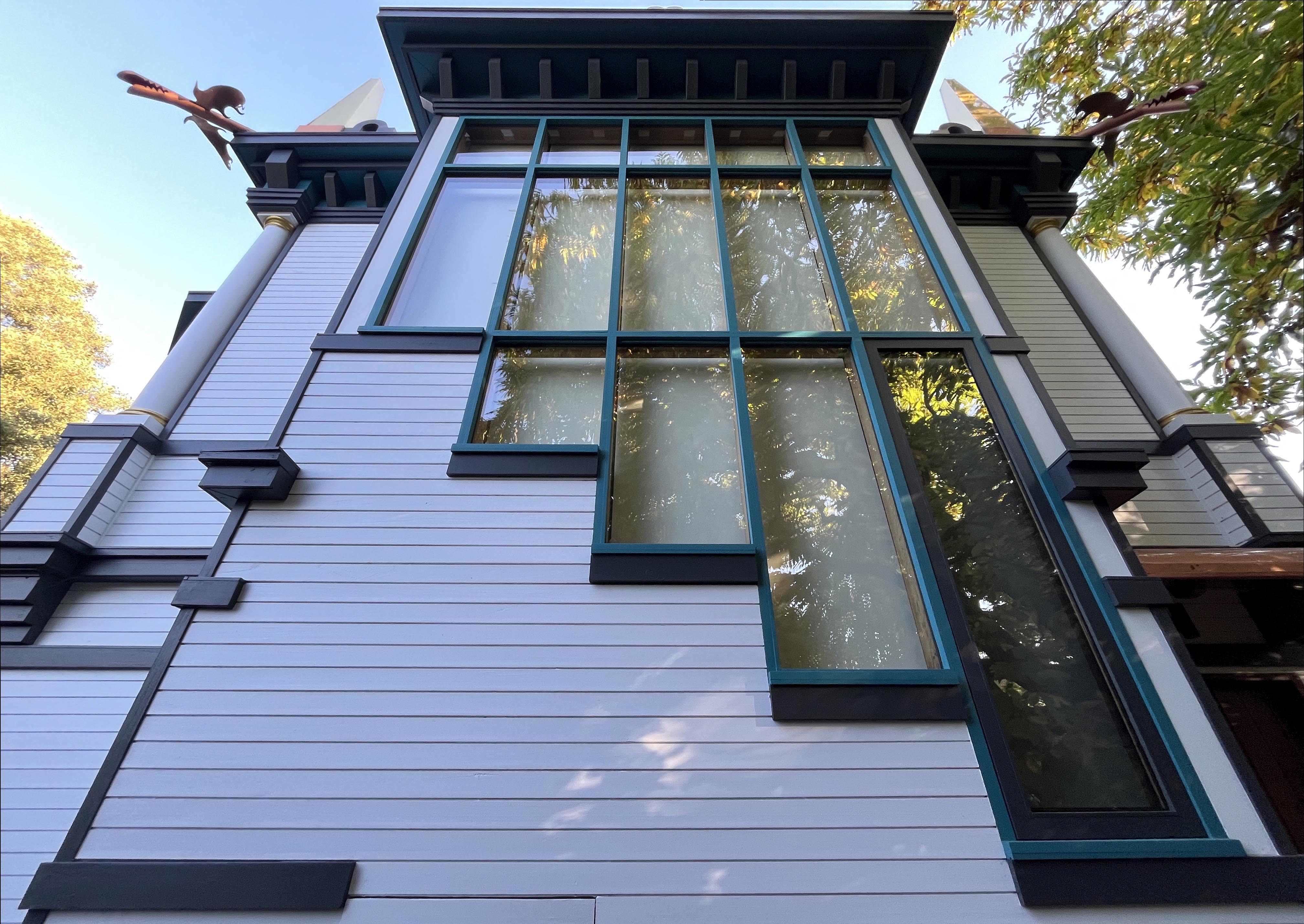
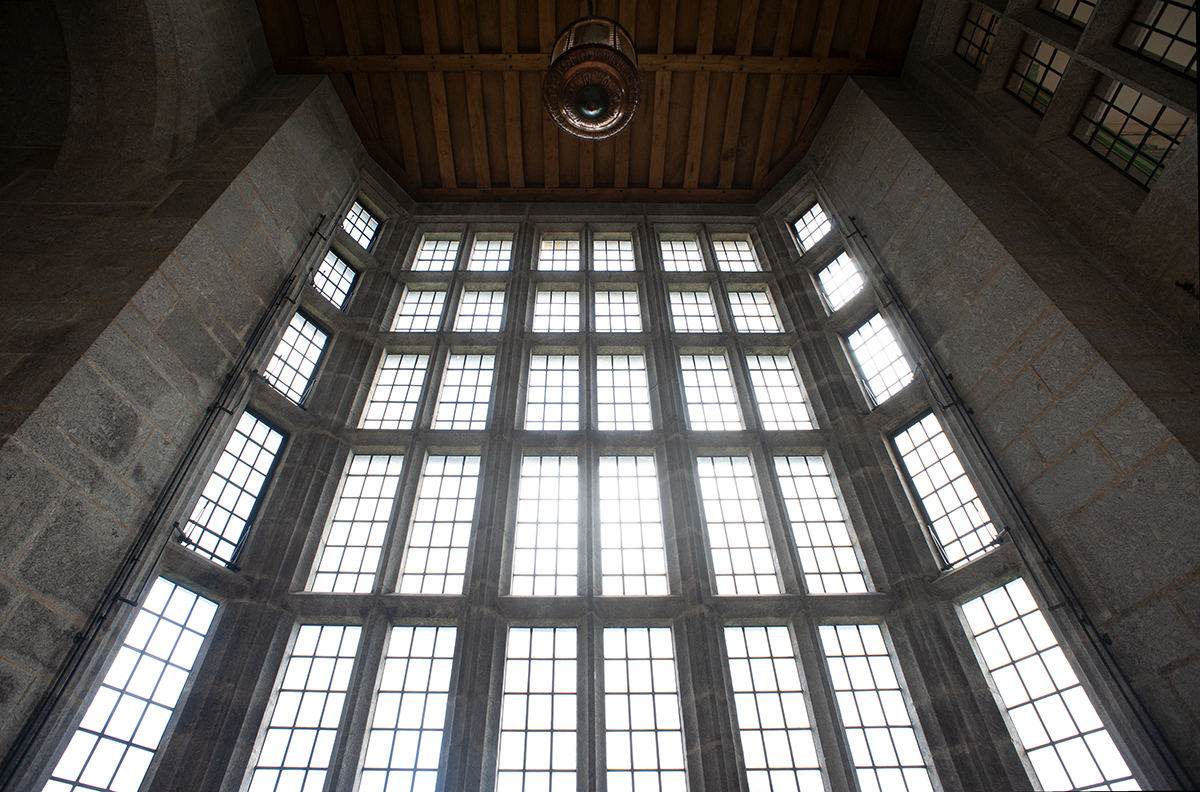
- (left) North face of Montacute Pavilion, showing staircase window
- (right) Castle Drogo, Devon, interior view of staircase window (architect: Sir Edwin Lutyens)
Changes in Plan and Designing from the Outside In
One significant change was driven by function. Non-classical architects since the Gothic Revival have favoured the practice of designing from the inside out. That is, focusing on the plan, which responds to function. The elevations are simply what results from his.
New Historicist Architecture, however, starts from the outside, because it is the image of the building that matters and is the starting point of the whole process. It is inherently pictorial: the point is to create a building that is good to look at. (It shares this with New Traditional Architecture.)
This can be a challenge for internal planning. An analogy is with Landmark Trust buildings in the UK. These are old buildings of great visual interest, like the one in the shape of a pineapple at Dunmore in Scotland, but are often awkwardly disposed within as adapted to holiday accommodation.
Montacute Pavilion is no different. But because it was designed from scratch, changes in planning were possible.
The Somerset pavilions are symmetrical, but I extended one of the bays bay to permit a big bathroom on the top floor and a second bedroom on the ground floor.
This causes the building to depart quite a long way from the model when seen from certain directions.
At this point the dangers of departing from the model become apparent.
Whereas the Somerset pavilions have four almost identical elevations, as a result of design process Montacute Pavilion has four different ones.
One, the west façade, corresponds to the Somerset pavilions, and hence for provides the prime view.
The north (staircase) face is difficult to see from a distance because of the chestnut trees. It is an interesting façade, providing a kind-of x-ray of the interior.
The south façade is the most awkward. It faces a symmetrical garden but is asymmetrical. The garden is at a lower level which makes it harder to see the roof than the west view.
The east façade, which is seen from the street, does not look much like the Somerset pavilions at all. It is much more dramatic, and rather Art Deco in feeling.
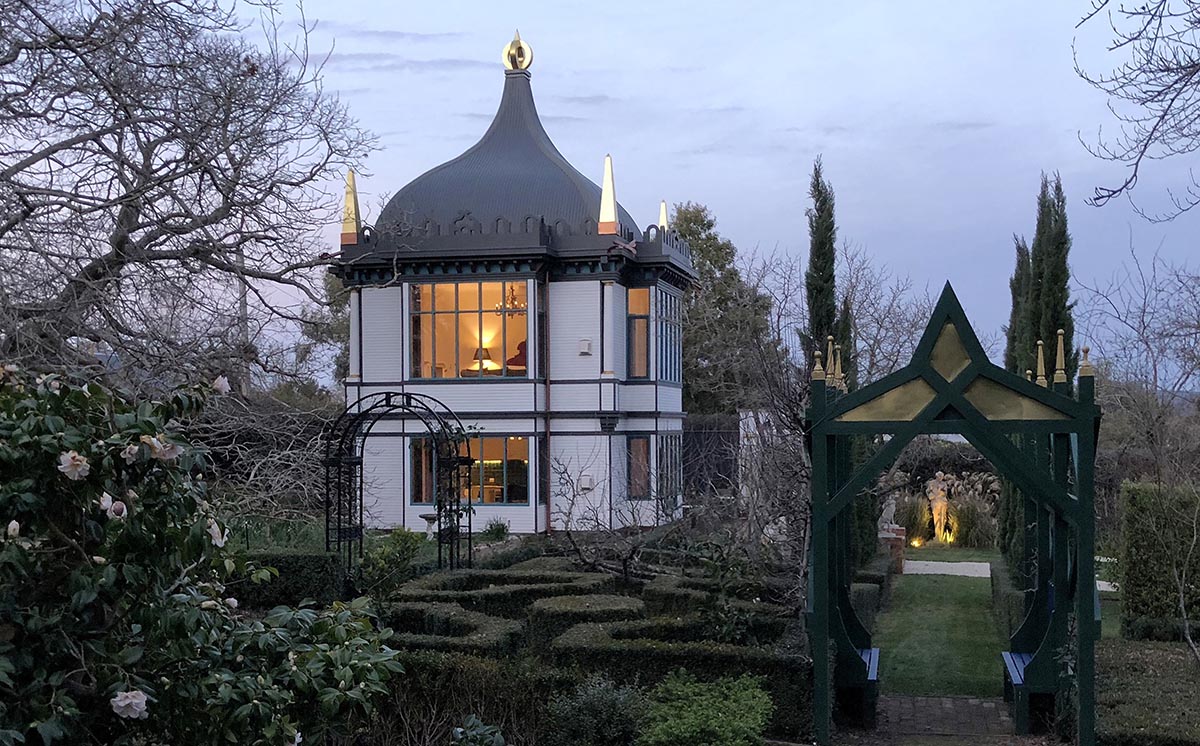
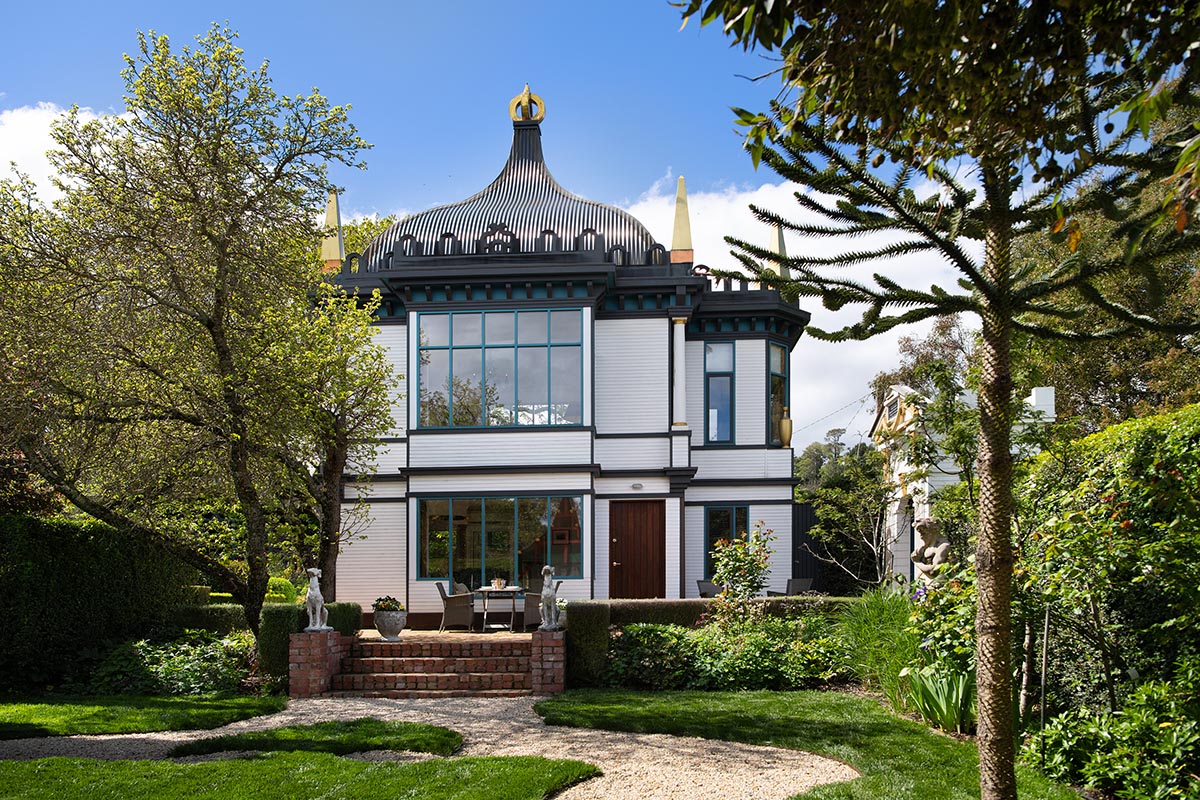
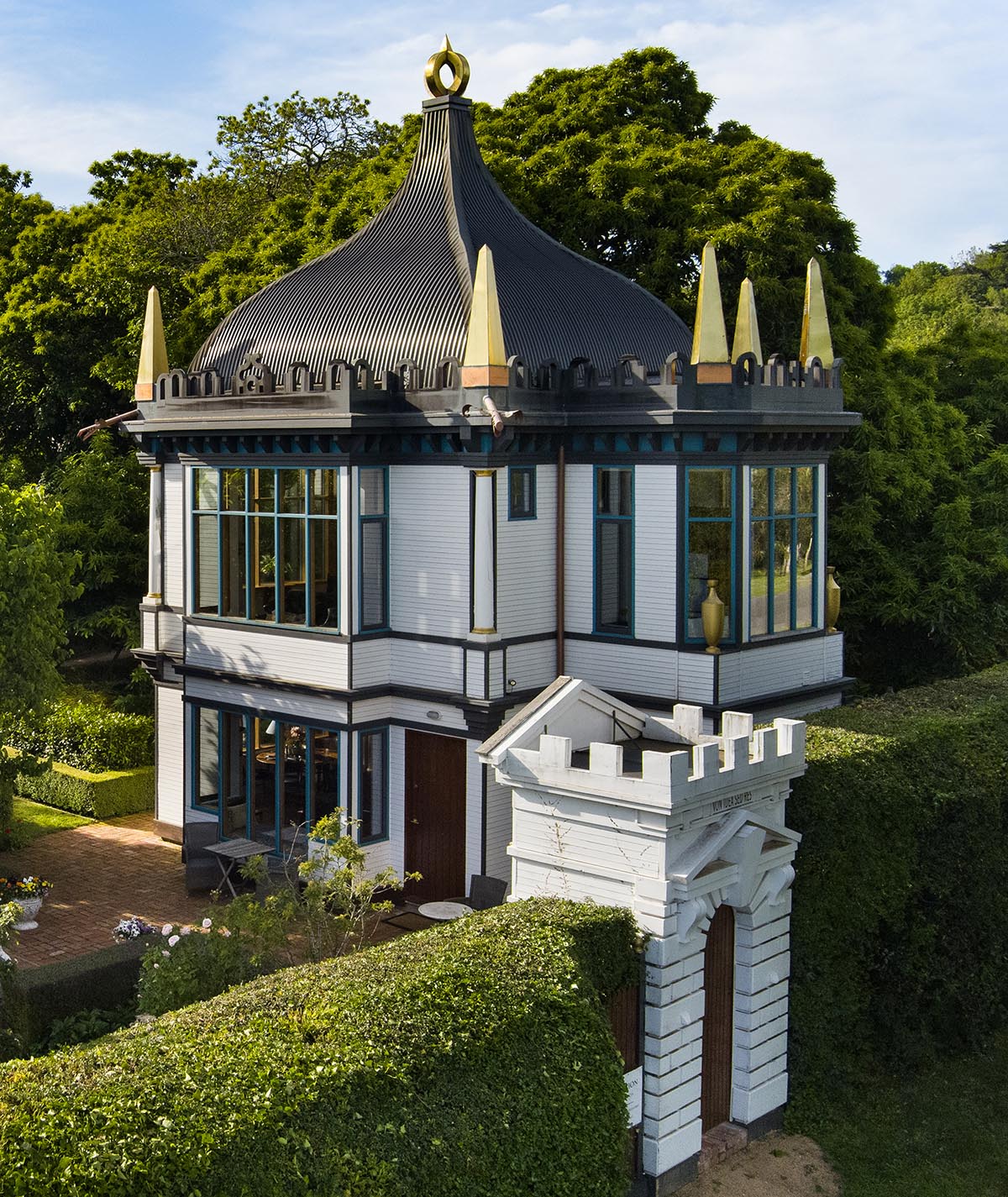
- (top left) Montacute Pavilion from the west
- (bottom left) Montacute Pavilion from the south
- (right) Montacute Pavilion from the north-east
An Original Design
Hence, through the design process I have sketched here, at Montacute Pavilion we have is in fact an original design.
But this originality would not have occurred if I had not begun with a model.
To be truly original you must begin by being unoriginal. You need to surrender to a model, and see where it takes you.
That, in a nutshell, is what Montacute Pavilion and New Historicist Architecture is all about.
[1] https://www.middletonfield.com/s/ Final+MF_DesignGuideines_FA_03-1.pdf accessed 26 November 2024.
[2] Banister Fletcher, A History of Architecture on the Comparative Method, first published 1896, revised by his son Banister Flight Fletcher in 1921. There was a new edition in 2019.


