For bookings, click here.
Notes on Montacute Pavilion by David R. Marshall
Montacute Pavilion was built in 2016 as a demonstration piece of New Historicist Architecture. The starting point for a work of New Historicist architecture is the study and identification of models. This distinguishes it from New Traditional Architecture, which is concerned with styles, or Modernism, which claims to work from principles rather than models, and resists being identified as a style. The choice of models is dictated by their perceived beauty and applicability to the task in hand. By studying models, the architect avoids the practice of starchitects, who strive for complete originality, which means that their works, though spectacular, can quickly lose touch with human values. And the trouble with originality is that, once achieved, it is no longer original. What matters is whether a building works and the effect it has on people. New Historicist Architecture employs forms that resonate with memory for those familiar with architectural history. These forms appear new to those not so informed, as it employs forms not part of the familiar built environment.
Historicism has been a bugbear of Modernist architects, who repeat to this day polemics formulate a century and a half ago against the historicism of late nineteenth century architecture. For example, the prospectus for the property development of Middleton Fields, on the other side of Wombat Hill, requires that the buyer must agree to certain rules. These include this statement:
‘The appearance of all homes must be of a high-quality contemporary design which complements the Daylesford character and the natural landscape. All historical styles or replica heritage design are prohibited including Colonial, Georgian, Victorian, Federation, Art Deco, 1950s-1980s brick veneer, and French Provincial.’[1]
This is a very old-fashioned prescription predicated on a now-outdated belief in period styles. In 1870 it was asked, if Classicism was the style of the Greco-Roman Period, and Gothic the style of the Medieval Period, what is the style of the nineteenth-century? The answer came in the early twentieth century: Modernism. This dogma is still repeated by Kevin McCloud in Grand Designs, who in every episode refers to a building being ‘of the twenty-first century’.
The belief in periods was based on metaphysical theories that no-one believes in anymore. There is no such thing as a period; it is merely a convenient construction built imaginatively from memories of matters existing in an arbitrary stretch of time, as when one sets out to define ‘the style of the 1980s’. This seems real until you realise you could just as well have asked ‘what is the style of 1977 to 1986?’. The Middleton Fields statement reflects the continuing belief in period-style compartments that was central to twentieth century architectural teaching, which has never really abandoned the ‘epitomisation’ of architectural history as presented by a long-popular textbook, Banister Fletcher’s A History of Architecture on the Comparative Method, especially the 1921 and later editions.[2]
New Historicist Architecture clears away these metaphysical cobwebs by working from models, not periods. A good example is the rebuilding of Notre Dame in Paris after the 2016 fire. A feature that was destroyed was the flèche, or little arrow-like spire built by Viollet-le-Duc in the nineteenth century. Modernist theory held that it must be replaced by a modernist design, because things built in the twenty-first century must be in the style of the twenty-first century; if not, they will be relegated to the ‘dustbin of history’. The passionate medievalists sought to rebuilt it in the original ‘perfect’ form it was supposed to have had in the thirteenth-century, a position as period-based as the modernist one, and equally fallacious, especially as, as recent studies have shown, medieval cathedrals never had an ‘original form’; they were, and are, a process. The final decision was the correct one: to reconstruct the form of Viollet-le-Duc’s flèche, necessarily in new (but not different) materials. In doing this another dogma was avoided: that the history of a building should be preserved come what may, including ugly1960s additions in concrete (or whatever). The correct reason for reconstructing Viollet-le-Duc’s flèche is that it was a feature of the church that had been much loved for a century or more: that it was perceived as beautiful.
We must leave this analogy at this point, because with Montacute Pavilion we are dealing with a new building. New Historicist architecture is not concerned with creating a replica, or with issues of authenticity, but with choosing a model that the creator at least believes to be beautiful. The model, of course, needs to be suitable for the task in hand. In this case the core idea was to have a garden pavilion that structured an empty part of the garden and was to be understood as a building subsidiary to the main house. Something like Schloss Luisium in the Gartenreich Dessau-Wörlitz in Germany: a small, two-storey building floating in the woods and not anchored to any other building. (Not so small actually; its dimensions are twice those of Montacute Pavilion.)

But the specific model is the twin pavilions in front of Montacute House in Somerset, now a property of the National Trust (UK). (See the postcards framed in the entranceway.) These have a highly structured relationship to the main house arrangement typical of grand Elizabethan houses: a rectangular courtyard in from of the garden façade, with banqueting pavilions at two corners and a gatehouse between them. The gatehouse is gone at Montacute House, but the scheme survives intact at Hardwick Hall. These pavilions were built by the mason-architect William Arnold in about 1598-1600 for Sir Edward Phelips. I have always admired these as some of the most beautiful small garden buildings I know. This does not make them perfect, however. The point of working from models is that the model is the starting point, to be both improved upon to rectify any defects that mar its perfection and adapted to a contemporary function using practical materials.


The model, therefore, can be altered. The question then becomes: what controls apply to changes made to the model? The principal control is that the design must not lose what it was that made the model attractive in the first place. In other words, each design decision must answer the question: will the retain the essential quality of the model be retained? Or will it be or lost? Or will it be it enhanced? This process is inherently Platonic: one is seeking the essential quality or ‘form’ that lies behind the model in order to preserve it in the new creation. Plato’s forms are metaphysical nonsense, but they reflect a psychological reality (as does the concept of beauty.)
This process is quite distinct from the practice employed by contemporary architects of quoting forms. For example, the design of the new contemporary art building for the National Gallery of Victoria quotes the big entrance arch of Roy Grounds’ 1968 building; it does not seek to retain the essential beauty of that building but merely uses this form to assert that the two buildings are connected.
In such a process, shape is paramount. This is distinct from, say, the Arts-and-Crafts aesthetic, which is preoccupied with (hopefully original) materials, or the modernist aesthetic, which is opposed to designing buildings on the basis of appearance, preferring that its appearance be merely the consequence of decisions based on planning and function (although starchitects, from Joern Utzon to Frank Gehry and Zaha Hadid, long ago dispensed with that particular dogma). It is necessarily a process of designing from the outside in, which no architect today would countenance. There are, of course, good practical reasons for this. If you commission an extension for your house from an architect, the whole discussion will be about planning and function; only at the end might appearance be addressed, which will mostly be a matter of finishes. But this makes buildings boring to look at. The cooler a building is, the less interesting it will be to look at from outside (the interiors may be another story). Indeed invisibility from the outside is frequently considered to be a virtue (‘it blends into the landscape’). The occupant-owner is primarily interested in what a building looks like from the inside, and the view from within. By contrast, the viewer beyond the fence, whether tourist or local, asks a building — necessarily the exterior —to speak to them. Few contemporary houses attempt to do this. For example, the houses built for The Block TV program on the edge of Wombat Park near the Farmer’s Arms roundabout are basically big corrugated Colorbond steel black sheds, devoid of exterior articulation.
The twentieth century architect who was best at conceiving buildings that presented an attractive image from the outside was Sir Edwin Lutyens. He made rapid perspective sketches, often from a low angle, which established the idea, or image, of the proposed building. For New Historicist Architecture an image of the model performs a similar role.
Montacute Pavilion is an accurate enlargement (120% bigger) of these pavilions, but with two main changes. The windows have been changed from the type with a semicircular bay with flat side lights to bigger rectangular bays of Elizabethan type such as are found in the main Montacute House building, and it has been extended on the street side to accommodate the master bathroom and the downstairs bedroom. This changes the look of the building somewhat: from the street, the effect is quite exotic; from the secret garden and the Chinoiserie fabrique it is more comlplicated, while the pure Montacute view is from the garden on the west side.

In accordance with New Historicist architecture principles, there has been no attempt to employ the materials of the model, but practical and economical contemporary ones. The roof is not slate, but curved corrugated Colorbond steel over a truss frame. This frame defeated trussmakers until I found one in Bendigo who resolved the problems, using two trusses, one nested inside the other. This was surprisingly cheap. During construction, because the open truss was nestled within the big chestnut tree, a cockatoo decided it looked tasty and ate through one of the timbers, which had to be prepared. The walls are standard timber framing, with silvertop ash shiplap cladding, chosen because of the narrow boards. The numerous mouldings and details are made from treated pine from Woodward’s in Ballarat. At the time they were producing what they called ‘smooth’ timber, which is unseasoned but dressed treated pine, in a wide range of standard sizes. Windows are double glazed cedar from Pickerings in Ballarat.
Elizabethan architecture demonstrates an interesting interaction between traditional Gothic forms and a new Renaissance interest in Classical forms. The ogee curve (reverse curve) of the roof is a traditional Gothic form that was a favourite roof form in Elizabethan buildings. The radius of both convex and concave sections is 2800 mm The original pavilions were dressed with classical columns at the corners and a classical entablature with modillions, topped by battlements. I found the battlements to be a little rudimentary and so developed somewhat different ones based on those at another Elizabethan building, Stanway House in the Cotswolds. The columns were cast in concrete from a firm in Preston that had the moulds.


These battlements are made of solid Accoya timber. This is a form of treated pine made with radiata pine treated with vinegar. It is not widely used in Australia and is therefore relatively expensive, but there are plants in the Netherlands and elsewhere that produce it. It is both more durable and more stable than the usual treated pine, and has been used for building bridges in Europe. It is also non-toxic: the company that made them, Charlie Sandford, for me told me that their workshop spelled like a fish-and-chip shop when they were making them. I made the modillions were made in treated pine, cut from standard 75 x 200 mm sleepers. The obelisks were made fby Charlie Sandford from Accoya and clad by me in sheet brass and copper. This zone is one of the most complex in the building. It is effectively one big box gutter
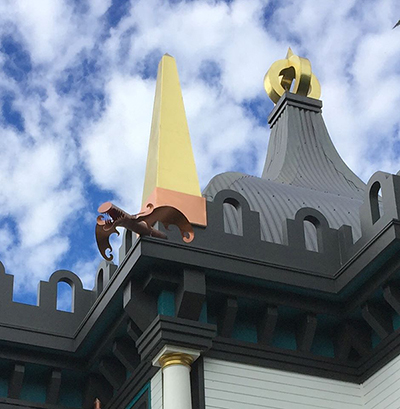
The feature that people find most striking are the obelisks and the finial on top, which are clad in brass and some copper. In the original pavilions these were of stone, but the translation into a timber building resulted in a different colouristic concept. Some people find them to be exotic, especially the colour, suggesting other building typologies, but they are meant to add a festive note. After all, it is a place for enjoying oneself, and who needs drab? The dragon spouts are a bit of whimsy. The model pavilions, like other Elizabethan buildings, get the water off the gutters through simple stone channel spouts. Click here and here for more about these. (Lead downpipes going down the walls were only introduced in the eighteenth century.) In Central Europe, however, from the seventeenth century it became customary to use metal spouts decorated as dragon heads. They are the equivalent of Gothic gargoyles. There is a seventeenth-century example in the Victoria and Albert Museum in London, and interesting examples, often remade, at Schloss Ambras, Innsbruck, Austria; Wawel Castle, Krakow, Poland; and at Schwäbische Hall, Germany. Seeing these in actions during heavy rain can be quite a sight. My dragon spouts are rather simpler but are functional as a secondary defence, though rainwater is normally removed through downpipes, as required by building regulations. The vases are not found in the Montacute pavilions but came about because the bathroom extension needed chamfered corner so as not to be too boxy, while the ground floor bedroom needed to be rectangular: the vases ease the transition, as well as providing visual interest from the bathroom, where they manage to look a little Art Deco. They are made of painted Accoya.
The design of the interior was driven by other considerations, as the. Model today is empty. Orientation was a crucial factor. The building is oriented to place the bathroom at the east in order to get the morning light, the bedroom facing the full depth of the garden on the west and looking over the Secret Garden on the south and with views toward Wheeler’s Hill. The staircase is placed on the north where it faces the big chestnut tree. I designed a grand, full height window here, which, of course, has nothing to do with the Somerset pavilions. It is inspired by the one by Lutyens at Castle Drogo and proved north light and views towards the botanical gardens. The bathroom is designed to be a festive place where you can linger, with a big bath for two and an apsidal shower niche glittering in black and gold. I had to get this specially made by a plaster company in Bendigo.
The decoration is somewhat inspired by Arts-and-Crafts examples, and we wanted to give it a timeless, country house feel, with quality furnishings chosen on the basic of beauty rarther than style or period. The fireplaces were designed in a Voyseyesque mode and made in American black walnut by Charlie Sandford.
[1] https://www.middletonfield.com/s/ Final+MF_DesignGuideines_FA_03-1.pdf accessed 26 November 2024.
[2] Banister Fletcher, A History of Architecture on the Comparative Method, first published 1896, revised by his son Banister Flight Fletcher in 1921. There was a new edition in 2019.